StartUp Founders: Actually Competent
Published April 19, 2026
Core Takeaway
TLDR
- Competence in a startup is not polish at your job; it is being good at not stopping. The real measure is the finish line.
- Wanting to win is not the signal. History is. Track record is guilty until proven innocent—show proof you finish when it matters.
- VCs are not selecting hobbies when they talk about gamers and marathon runners; they are signal hunting for intolerance of average and evidence you go the distance.
- Grit is passion plus persistence. Under pressure, startups externalize weakness: the reflex becomes "this isn't working" instead of "I need to work harder."
- Startups are built on repetition, frustration, iteration, long periods of being wrong, and clock speed—not motivation.
- If you do not have proof yet, practice on something small and hard with a finish line before your startup becomes the only exam.
Newsletter
Hey Reader,
Competence in a startup isn't about being good at your job, it's about being good at not stopping. Therefore the real / true measure of your competence is the finish line.
Which means competence for a founder is just persistent repetition.
Wanting to win is not the signal. History is. So show me the proof that when it actually matters, you don't quit, that you are competent.
Show me any proof from any time in your life that you finish the job, do the thing, overcome the adversity, fight the pain or crush the market.
It's not mandatory, but you can't argue that it's a good signal for a founder to have...
All things even, which runner would you bet on to finish the marathon? The one that has done it, or the one that looks fantastic, has all the gear, the physique, and a PhD in how to run?
If you can't think of a time that you "finished the job" and this startup is the first place where you super-duper-promise that when it gets tough you will fight, then it's reasonable to believe that you won't, because we have no supporting evidence that you will. Track record is guilty until proven innocent. The default is I doubt you, until you prove otherwise.
Proof undeniable is not a mandatory requirement; we are just talking about signal hunting and combining with a little survivorship bias, plenty of shit entrepreneurs run marathons... this trait alone is not the recipe for success, but without it, the rest might not matter.
The startup word for this would be GRIT aka passion plus persistence. Angela Duckworth wrote about what predicts success at West Point and it came down to this.... The cadets who had a history of sticking with hard things were the ones who didn't drop out (not IQ, not muscle, not bloodline).
You don't discover you are a warrior in a startup, you don't suddenly become that person because the stakes are higher, or because you promised your family, or owe it to your investor. You don't unlock more fucks because now you "care more" in reality, you either have the trait and bring it with you, or you don't, or for so many of you.. you discover you always had it.
So again… show me a moment where you refused to be average and executed like it. Show me where you actually pushed, stayed longer than anyone, did the thing, where losing bothered you enough to win, to overcome, to do the thing.
Sorry, I really like this line and I fear you might not have heard it when I first said it... Wanting to win is not the signal. History is.
You've probably heard this show up in a weird way when VCs talk about founder types on any podcast that will let them speak. They talk about these common traits across their portfolio. Things like leet gamers, marathon runners, kids who started a car wash at 9, people who go deep on topics that don't matter.
It sounds a bit random, biased and almost a bit mean if you are not in one of those groups, but it is not that. They are not selecting for the hobby; they are just trying to signal hunt, to pattern match for a very, very simple trait... Evidence that you don't tolerate average (and if they give you their money, you are more likely than not to go all the way, or at least go down fighting).
In case it's not clear....
A leet gamer isn't interesting because they game. They're interesting because they spent a stupid number of hours getting incrementally better at something hard, with no external reward.
A marathon runner isn't interesting because they run. They're interesting because they've proven they can push through discomfort for long periods without quitting.
The kid with the car wash isn't interesting because of the business. They're interesting because they chose to act instead of wait.
It doesn't have to be big, athletic or entrepreneurial or impressive on a CV. Maybe you solved a Rubik's Cube until you could do it in under a minute. Maybe you learned an instrument badly for years and kept going. Maybe you were the person who stayed late on a project no one cared about because you cared about it. The size doesn't matter. The pattern does.
Most people I speak to don't even realize they have the trait. The immigrant who moved to a new country with zero and built a life? The Mum (or Dad) who raised a kid alone while working full-time? If you've endured something that would have broken most people and you're still here then you have the trait, but you are probably calling it "life" and never thought to call it "grit". High fives to you.
The reason it's a newsletter, is because startups don't introduce pressure; they amplify it. They take whatever and whoever you already are under pressure and turn it up. You don't suddenly become relentless because you went to Doola and incorporated your Delaware corp (Not an ad. Use them or Stripe Atlas!).
So many founders feel stuck, lost, stupid, or the world has something against them, and it's not because they lack smarts, ambition, or ideas - it is often because they've never actually proven to themselves that they can stay in something long enough for it to work so they don't know what it looks like.
So when shit gets hard (and it always does), the reflex or the internal interpretation becomes externalized (this isn't working) vs. internalized (I need to work harder).
That's it. The rest is fluff. Startups are not built on motivation, they're built on repetition. Frustration. Iteration. Extreme periods of being wrong. They are built on clock speed. How quickly can you deploy, listen, learn, iterate, deploy?
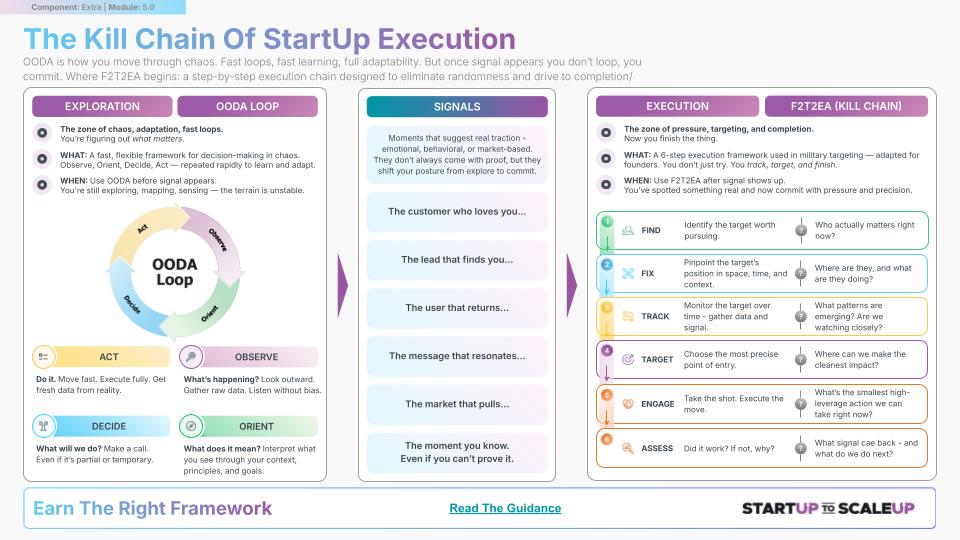
And if you don't have that skill, also fine, but don't lie to yourself about what you're signing up for, that this time will be different because the stakes are higher.
If you don't have the proof yet, maybe go get it? Maybe not with your startup, feels like an expensive place to practice, maybe pick something small and hard with some version of a finish line? Then do it, and do it again.
If I can be of service, feel free to grab time.
LFG.
- James
Frequently Asked Questions
More Newsletters

Current-You: Why You Can Punt Your Hardest Problems (And What Has To Be True First)

The Efficiency Edge: Why Uber Won on a Click, Not a Subsidy War
The Arsonist Founder: Why Most Startup Fires Are Self-Inflicted and How to Break the Pattern
Continue Your Founder Journey
Explore all the resources available to help you build and scale your startup
Startup Frameworks Library
Subscribe to the Newsletter
Join 140,000+ founders getting exclusive strategies, frameworks, and founder stories every Sunday.
Get instant access to the 50-Step Founder Playbook downloaded over 1M times